
A Keffiyeh, a Legacy, and a Woman Who Won’t Back Down
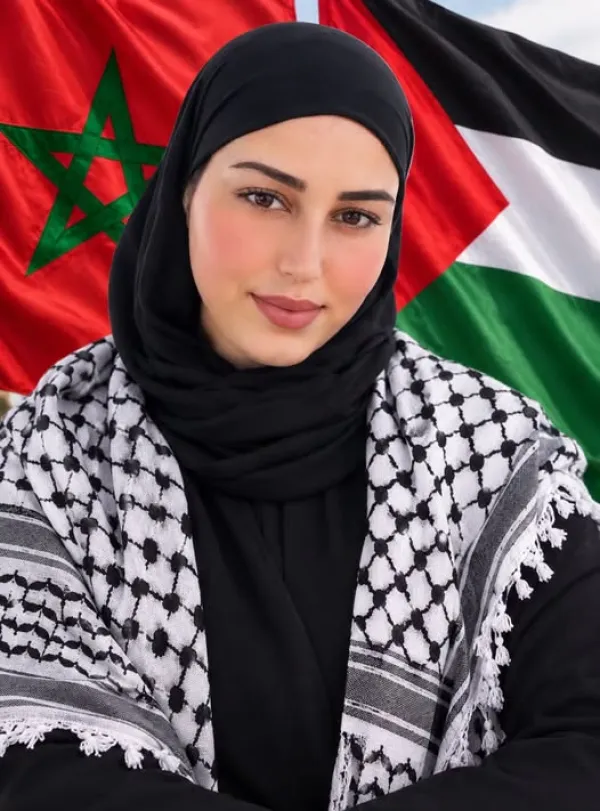
Hajar Benfares: Moroccan pride, Palestinian solidarity, and the courage to stand by her convictions. Photo credit: Hajar Benfares’s Facebook page
Hajar Benfares of Casablanca, Morocco, has a message for those who question her patriotism because she wears a Palestinian keffiyeh: solidarity with Palestine does not make her any less Moroccan. On the contrary, she says, her commitment to justice is rooted in her family’s own history of resistance.
In a recent Facebook post, Hajar Benfares (in the picture) described the online trolls who emerge whenever she shares a photograph of herself wearing the traditional Palestinian scarf. She said their attacks expose what she considers their pro-Zionist sympathies, hidden behind slogans of patriotism.
“I am more patriotic than any of you,” she declared.
Hajar explained that her grandfather took up arms in the struggle for Morocco’s independence, while her grandmother helped build the city of Fes, where the family home served as a hiding place for weapons used against colonial forces.
“This legacy of struggle did not emerge overnight,” she wrote. Raised in a family of fighters, including her aunts, mother, and father, Hajar sees her activism as an inheritance passed down through generations.
Her commitment to Palestine, she insists, will never waver. She stands with Gaza’s children and all Palestinians and rejects normalization with Israel.
Her patriotism, she explained, is not in conflict with her solidarity. Morocco comes first among her national commitments, but Palestine remains a cause of profound significance to the Muslim Ummah (community), as the land of prophets and the site of Islam’s first qibla (direction of prayer).
Hajar makes an important moral point: even if Palestinians were not Muslims, the injustice they face would still demand our solidarity. Human suffering does not become less deserving of compassion because of a person’s religion or identity.
I must confess that Hajar’s photograph caught my attention, too. With a gentle smile and a composed, confident gaze, she presents a graceful, dignified image. Her black hijab frames her face, while the Palestinian keffiyeh rests over her shoulders. Behind her, the Moroccan and Palestinian flags create a striking portrait of heritage, pride, and solidarity.
And let me make one thing clear: genuine admiration is not a competition, nor does appreciating a woman’s beauty mean being romantically attracted to her. It means recognizing something beautiful in another person without feeling threatened by it.
May God protect and bless Hajar. Her courage reminds us that patriotism and solidarity with an oppressed people need not be enemies. May she remain steadfast in her convictions and find the strength to rise above the noise of those who seek to silence her.
Salutations to Hajar Benfares—and to all those who refuse to let conscience be silenced.
Mahmoud El-Yousseph is a Palestinian freelance writer and retired U.S. Air Force veteran. He writes about U.S. foreign policy, Middle Eastern affairs, and justice